
Trump Says ‘Killing Has Stopped’ in Iran as U.S. Reviews Next Steps

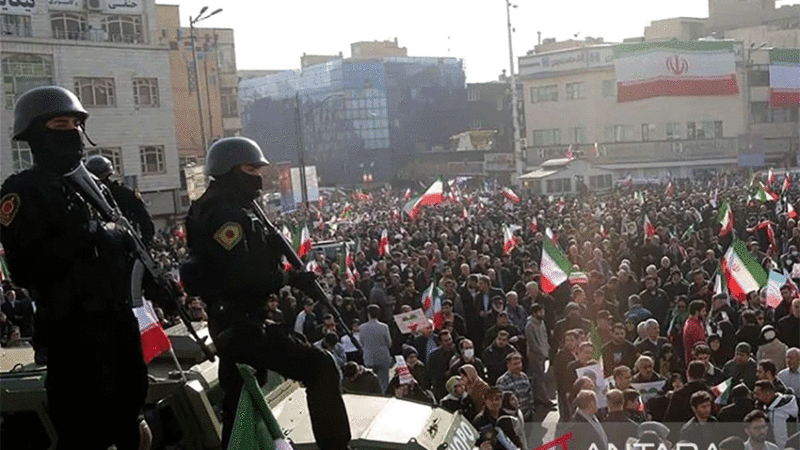
Journey Tribune – Former U.S. President Donald Trump stated early Thursday that executions of detained protesters in Iran have been halted, citing what he described as reliable intelligence. His remarks come amid intensifying international scrutiny of Iran’s ongoing crackdown on dissent and as the United States considers potential military and diplomatic responses to the escalating crisis.
Speaking to reporters, Trump said he had been informed “on good authority” that Iranian authorities had called off planned executions of individuals detained during recent protests. “The killing has stopped,” Trump asserted, framing the development as a potentially significant shift in Tehran’s approach following weeks of mounting global condemnation.
Despite the claim, Trump emphasized that the situation remains fluid and unresolved. He confirmed that his administration is continuing to evaluate possible courses of action, including military options, while closely monitoring developments inside Iran. “We are watching this very carefully,” he said, noting that no decisions had yet been finalized regarding direct intervention.
Iran has been engulfed in widespread unrest following mass demonstrations that erupted in response to political repression, economic hardship, and alleged human rights abuses. According to a U.S.-based human rights organization, at least 2,400 protesters have been killed since the crackdown began, although independent verification has been limited due to severe restrictions on media access and communications.
The Iranian government has imposed a near-total communications blackout lasting almost a week, sharply curtailing internet access and mobile connectivity across the country. Rights groups argue that the blackout has enabled security forces to escalate their response away from public scrutiny, complicating efforts to assess the true scale of casualties and detentions.
Trump’s statement regarding the halt in executions has not been independently confirmed by Iranian officials, who have remained largely silent on the issue. Analysts caution that Tehran may be attempting to ease international pressure without fundamentally altering its internal security strategy. “A pause does not necessarily signal a policy reversal,” said one Middle East analyst familiar with Iranian internal dynamics. “It may be a tactical move to reduce external pressure.”
Meanwhile, concerns over regional stability continue to grow. U.S. officials have advised some American personnel to temporarily leave a U.S. military base in Qatar as a precautionary measure, according to sources familiar with the matter. While the move was described as preventative rather than reactive, it underscores heightened anxiety about potential spillover effects should tensions escalate further.
Several countries, including European and Middle Eastern nations, have issued advisories urging their citizens to leave Iran while commercial travel options remain available. Airlines have begun rerouting flights to avoid Iranian airspace, citing safety concerns tied to the volatile security environment and the possibility of military confrontation.
Trump acknowledged these developments, stating that protecting U.S. citizens and allies remains a top priority. He also suggested that Iran’s leadership is acutely aware of the international reaction to its domestic policies. “They know the world is watching,” he said. “Pressure works.”
The situation has reignited debate in Washington over the appropriate balance between diplomatic pressure, economic sanctions, and military deterrence. Some lawmakers have called for intensified sanctions targeting Iran’s security apparatus, while others have urged caution, warning that military escalation could further destabilize the region.
Human rights advocates have welcomed any indication that executions may have been halted, but stress that broader accountability is still urgently needed. “Stopping executions is a critical first step, but it does not address the thousands already killed or imprisoned,” said a spokesperson for a prominent international rights organization. “Sustained international engagement is essential.”
Within Iran, the communications blackout continues to obscure conditions on the ground. Families of detainees have reportedly received little to no information about the status of their loved ones, while activists fear that arrests are ongoing behind closed doors. The lack of transparency has fueled anxiety and speculation both domestically and abroad.
Trump reiterated that his administration would not ease pressure prematurely. “We will continue to monitor the situation closely,” he said, adding that any future U.S. response would be guided by developments on the ground and Iran’s willingness to de-escalate.
As uncertainty persists, the international community remains on alert. Whether the reported halt in executions represents a meaningful turning point or a temporary pause remains unclear. What is certain, however, is that Iran’s internal crisis has now evolved into a broader geopolitical issue—one with significant implications for regional security, human rights, and U.S. foreign policy.
For now, Trump’s declaration that “the killing has stopped” offers a momentary glimmer of hope, even as questions remain about what comes next and whether lasting change will follow.
