
Trump Escalates Response as ICE Protests Shake Minneapolis

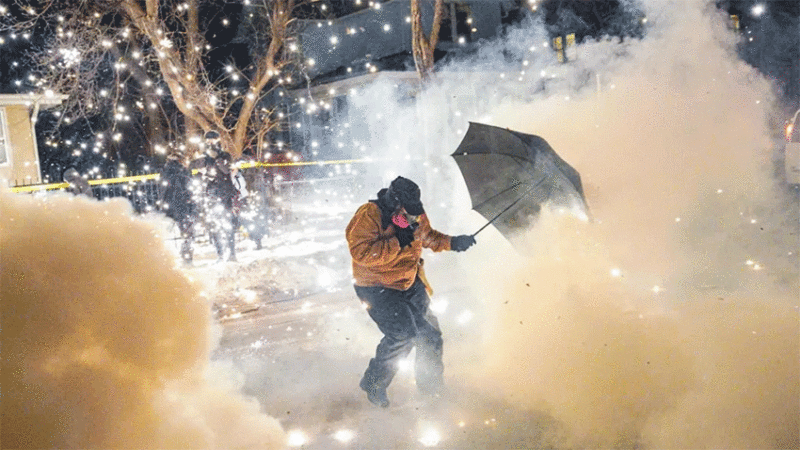
Journey Tribune – Minneapolis, Minnesota — U.S. President Donald Trump has threatened to invoke the rarely used Insurrection Act as tensions escalate in Minneapolis following violent protests linked to federal immigration enforcement operations. The warning comes after clashes between demonstrators and law enforcement erupted this week, amid growing outrage over two separate shootings involving Immigration and Customs Enforcement (ICE) agents.
In a post on his Truth Social platform, Trump said he would not hesitate to deploy active-duty military personnel if state and local authorities failed to restore order. He accused what he called “professional agitators and insurrectionists” of exploiting public anger and warned Minnesota officials to act swiftly.
The immediate trigger for the latest unrest was a confrontation late Tuesday in north Minneapolis, where a federal immigration agent shot a man in the leg following what authorities described as a violent attack. According to the Department of Homeland Security (DHS), the incident unfolded after a car chase involving Julio Cesar Sosa-Celis, a Venezuelan national previously convicted of driving without a license.
DHS said that after the pursuit ended, Sosa-Celis exited his vehicle and physically confronted the agent. Two other Venezuelan nationals — Alfredo Alejandro Ajorna and Gabriel Alejandro Hernandez-Ledezma — reportedly emerged from a nearby apartment and joined the confrontation. The three men allegedly attacked the officer with a snow shovel and a broom handle, prompting the agent to open fire in what officials described as self-defense.
The agent and Sosa-Celis were both taken to the hospital with non-life-threatening injuries. All three men were arrested at the scene.
“What we saw last night in Minneapolis was an attempted murder of federal law enforcement,” DHS Secretary Kristi Noem said in a statement. She described the officer as having been “ambushed and attacked” and defended the decision to fire a single defensive shot.
The shooting ignited fresh protests in the Hawthorne neighborhood near the scene. Demonstrators clashed with federal agents and city police, who deployed crowd-control measures including pepper balls and munitions. Police Chief Brian O’Hara said officers were struck by fireworks, ice, and snowballs during the unrest.
Several federal vehicles were vandalized, and property was stolen, according to the Federal Bureau of Investigation (FBI). On Thursday, the FBI announced it was offering a reward of up to $100,000 for information leading to the recovery of stolen government property or the arrest of those responsible for the damage.
The unrest is unfolding against the backdrop of a broader immigration enforcement surge in Minnesota. Roughly 3,000 federal officers have been deployed to the state in recent weeks as part of what the Trump administration calls “Operation Metro Surge,” a campaign aimed at intensifying arrests of undocumented immigrants in major metropolitan areas.
Tensions have been particularly high since January 7, when ICE agent Jonathan Ross fatally shot Renee Nicole Good, a 37-year-old woman, during a traffic stop in Minneapolis. The incident sparked nationwide protests and renewed scrutiny of ICE’s use of force.
The Trump administration maintains that Ross acted in self-defense, while local officials dispute that account, arguing that Good posed no imminent threat. Video footage circulating online shows ICE agents surrounding Good’s car as it sat in the middle of the street. As she attempted to drive away, one agent standing in front of the vehicle fired three shots. The FBI is currently investigating the shooting.
The death of Good has deeply divided the community. An online fundraiser established for her widow and family has raised more than $1.4 million, while a separate fundraiser supporting Ross has collected approximately $740,000, underscoring the polarized public response.
Minnesota Governor Tim Walz, a Democrat, urged calm and appealed directly to the president to de-escalate the situation. “Let’s turn the temperature down,” Walz wrote on social media, adding that Minnesotans “cannot fan the flames of chaos.” Walz, who once referred to ICE as a “modern-day Gestapo,” recently announced he would not seek re-election following a fraud scandal involving state welfare programs.
Minneapolis Mayor Jacob Frey has also called for ICE to leave the city, warning that the current situation is unsustainable. “No matter what led up to this incident, the situation we are seeing in our city is not sustainable,” Frey said in a post on X.
Trump’s threat to invoke the Insurrection Act — a 19th-century law that allows the president to deploy the military for domestic law enforcement — marks a significant escalation. While Trump previously floated the idea during past periods of unrest, he has never formally invoked the law.
On Wednesday, a federal judge denied a request from Minnesota prosecutors to temporarily block ICE operations, clearing the way for Operation Metro Surge to continue.
As protests persist and political tensions sharpen, Minneapolis finds itself at the center of a national debate over immigration enforcement, federal authority, and the limits of force — with the prospect of military involvement raising the stakes even higher.
