
Is The Rip Rooted in Reality? The True Story Behind the Crime Thriller

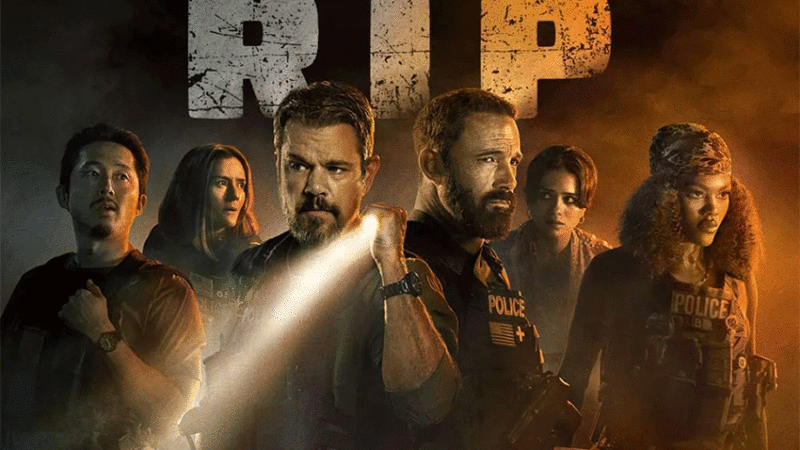
Journey Tribune – Netflix’s latest crime thriller, The Rip, has quickly drawn attention not only for its star power but also for its claim to authenticity. Starring longtime collaborators Matt Damon and Ben Affleck, the film follows two Miami police officers whose routine operation spirals into a tense moral and psychological battle after they uncover a massive cache of cartel money. While the movie unfolds with the pacing and intensity of a classic Hollywood thriller, its origins lie in a real-life police case that is both extraordinary and deeply personal.
Directed and written by Joe Carnahan, The Rip centers on Lieutenant Dane Dumars (Damon) and Detective Sergeant J.D. Byrne (Affleck), members of Miami-Dade’s Tactical Narcotics Team. During a raid on a derelict stash house, the officers discover more than $20 million concealed inside the walls of the property. Under Florida law, officers are required to count seized cash at the scene before it can be removed, a procedural detail that becomes the foundation for the film’s mounting tension.
As night falls and the counting begins, the team realizes they are racing against time. The cartel members who hid the money could return at any moment, and the prolonged confinement begins to erode trust among the officers themselves. According to Carnahan, the story is less about action than it is about human pressure. “They’re forced to count the money without really knowing who to trust,” he explained in interviews tied to the film’s release. “That uncertainty includes their own teammates.”
The ensemble cast includes Steven Yeun, Teyana Taylor, Catalina Sandino Moreno, Sasha Calle, Kyle Chandler, and others, adding layers of interpersonal conflict and suspicion to the claustrophobic scenario.
A Real Case at the Core
Despite its dramatic flourishes, The Rip is indeed inspired by a real event involving Chris Casiano, a Miami-Dade police officer who once led the department’s Tactical Narcotics Team. During an operation, Casiano and his unit discovered a staggering amount of cartel cash hidden within a house—stuffed into containers embedded in the walls and extracted with sledgehammers. The bizarre details of the discovery, including a frantic dog barking outside the property, left a lasting impression on Carnahan, who was a close personal friend of Casiano.
Carnahan has described the moment he heard the story as revelatory. While films have long explored police corruption and drug enforcement, he said he had never encountered a true account quite like this one. That experience became the narrative seed for The Rip, but it was far from the only influence shaping the film.
Grief as a Driving Force
One of the film’s most emotionally charged elements—the grief experienced by Damon’s character over the death of his young son—is drawn directly from Casiano’s life. In reality, Casiano lost his son, Jake William Casiano, to leukemia in 2021. The loss profoundly affected him, and Carnahan has said the film was, in part, an attempt to process and honor that grief through storytelling.
In The Rip, Dumars is portrayed as a man struggling to hold himself together under the weight of professional responsibility and personal devastation. The film is dedicated to Jake, and Carnahan has openly acknowledged that the project served as a kind of memorial. He has described the creative process as emotional and imperfect, but sincere—an effort to transform unbearable loss into something meaningful.
When Casiano saw the finished film ahead of its release, Carnahan said the experience was overwhelming for both of them. The director emphasized that Jake’s name needed to appear prominently, signaling that beneath the crime-thriller framework lies a deeply human story.
Fact Versus Fiction
While the discovery of the money and the procedural requirement to count it on-site are accurate, much of what unfolds afterward is fictionalized. The film’s portrayal of corruption, violent confrontations, and morally compromised officers was invented for dramatic effect. In reality, there was no bloody standoff or betrayal among Casiano’s team.
However, some details are strikingly true. Counting seized cash is an exacting process, governed by strict oversight. In Casiano’s case, the counting reportedly took 42 hours and required multiple verifications by hand. Any discrepancy—even a single dollar—could trigger an Internal Affairs investigation. At one point, those present were so exhausted that even the property owner was enlisted to help count.
Carnahan has said his responsibility as a filmmaker was to distill the most cinematic elements of the story while respecting the truth. Compressing a nearly two-day process into a feature-length film required significant narrative shortcuts, but the essence of the experience remained intact.
The Final Number
In a rare alignment between Hollywood and reality, the final sum revealed in The Rip—$20,650,480—matches the exact amount Casiano found in real life. According to Carnahan, the moment was recreated almost exactly, down to a business card used to confirm the total. For the director, it was a quiet but powerful affirmation that, despite temptation and pressure, the real officers did the right thing.
The Rip is now streaming on Netflix, offering audiences a crime thriller that blends classic genre influences with a grounded, emotionally resonant true story—one that ultimately underscores the importance of integrity, the cost of loss, and the human cost behind the badge.
