Doomsday Clock 2026: Why Urgent Action Could Change Humanity’s Future

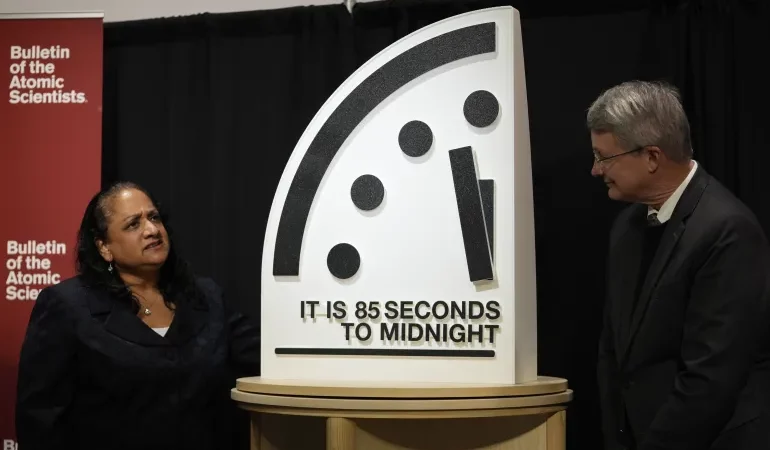
Journey Tribune – Scientists have issued a serious warning to the global community after the symbolic Doomsday Clock was moved to just 85 seconds before midnight for the year 2026. This setting represents the closest the clock has ever been to midnight since it was first introduced in 1947. The announcement reflects the most pessimistic evaluation of humanity’s future made by the Bulletin of the Atomic Scientists in its long history.
The Doomsday Clock is a symbolic representation of how close the world is to a catastrophic event caused by human actions. Midnight symbolizes global destruction, while the distance from midnight reflects the level of danger facing humanity. The clock is adjusted annually based on scientific assessments of global threats.
The Role of the Bulletin of the Atomic Scientists
The Bulletin of the Atomic Scientists is a non-profit organization founded by Albert Einstein and other leading scientists in the aftermath of World War II. Its primary mission is to inform the public and policymakers about threats posed by nuclear weapons, climate change, and emerging technologies. Through the Doomsday Clock, the organization aims to communicate complex global risks simply and powerfully.
In its 2026 assessment, the Bulletin concluded that global conditions have worsened significantly. The organization warned that international cooperation is declining at a time when unity is more necessary than ever. Instead of working together, many countries are pursuing narrow national interests, increasing global instability.
Rising Nuclear and Geopolitical Tensions
One of the main reasons for moving the clock closer to midnight is the growing risk of nuclear conflict. According to the Bulletin, major world powers such as the United States, Russia, and China are becoming increasingly aggressive and confrontational. Long-standing arms control agreements are weakening or collapsing, reducing transparency and trust between nuclear-armed states.
The assessment highlighted several major conflicts that occurred in 2025, including Russia’s ongoing war in Ukraine, violent clashes between India and Pakistan in May, and military attacks on Iran carried out by the United States and Israel in June. These events demonstrate how quickly regional disputes can escalate into larger international crises, especially when nuclear weapons are involved.
Climate Change as a Global Emergency
Climate change was identified as another major factor contributing to the worsening global outlook. The Bulletin stated that national and international responses to the climate crisis have been largely inadequate. Some policies have even worsened the situation by encouraging continued reliance on fossil fuels.
The organization criticized recent United Nations climate summits for failing to strongly promote the phasing out of fossil fuels or for lacking effective systems to monitor carbon dioxide emissions. It also expressed concern over the United States’ climate policies under President Donald Trump, which it described as hostile to renewable energy and environmental protection efforts.
Progress and Limitations in Renewable Energy
Despite these concerns, the Bulletin acknowledged positive developments in the energy sector. In 2024, renewable energy sources such as wind and solar power experienced record growth in both capacity and electricity generation. In addition, renewable and nuclear energy combined accounted for more than 40 percent of global electricity generation for the first time.
While this progress is encouraging, the organization warned that it is not happening fast enough to offset the accelerating impacts of climate change. Without stronger political commitment and international cooperation, the benefits of renewable energy expansion may be insufficient to prevent long-term environmental damage.
The Historical Context of the Doomsday Clock
Since its creation in 1947, the Doomsday Clock has been adjusted many times to reflect changes in global risk. The safest period was recorded in 1991, following the end of the Cold War, when the United States and Russia agreed to significantly reduce their nuclear arsenals.
In contrast, the clock was set to three minutes before midnight in 1984, during a period of extreme tension between the United States and the Soviet Union. At that time, diplomatic communication had nearly collapsed, increasing the risk of nuclear confrontation.
New Threats and the Decline of Global Cooperation
In recent years, the Bulletin has expanded its focus beyond nuclear weapons to include climate change, biological risks, and emerging technologies such as artificial intelligence. These challenges are becoming more complex and interconnected, requiring coordinated global responses.
Daniel Holz, Chair of the Bulletin of the Atomic Scientists and a professor at the University of Chicago, warned that the rise of nationalistic and authoritarian governments is making international cooperation more difficult. He emphasized that global problems cannot be solved through isolation or rivalry.
The Urgent Need for Collective Action
The Bulletin concluded that the movement of the Doomsday Clock to 85 seconds before midnight is a clear call to action. Scientists stressed that while the risks are severe, they are not unavoidable. Meaningful change is still possible if governments, institutions, and citizens demand responsible leadership and commit to cooperation.
According to the Bulletin, humanity’s survival depends on rebuilding trust between nations, strengthening international agreements, and taking decisive action to reduce nuclear risks and address climate change. Without such efforts, the world may continue moving closer to irreversible catastrophe.
