
Did Alligator Meat Fuel the Chicago Bears’ Glory?

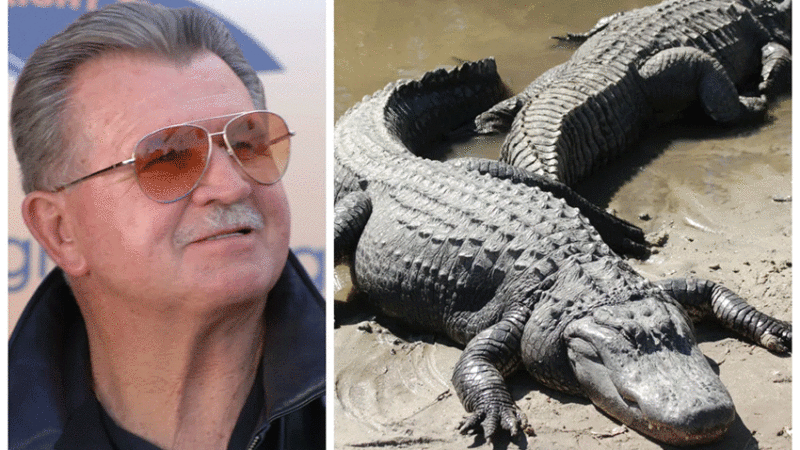
Journey Tribune – Superstitions have long been woven into the fabric of professional sports, from lucky socks to ritualized routines that athletes and coaches refuse to abandon. For the Chicago Bears of the 1980s, however, one of the most enduring — and unusual — traditions involved neither prayer nor polished talismans, but a dinner plate. Specifically, alligator meat.
More than four decades ago, then–Bears head coach Mike Ditka stumbled into what he believed might be a winning formula during a road trip to Florida. In 1983, on the eve of a game against the Tampa Bay Buccaneers, Ditka and Bears general manager Jerry Vainisi sampled alligator meat. The Bears went on to win the game. For Ditka, that coincidence was enough to turn a curious meal into a full-fledged ritual.
Two years later, as the Bears were storming through the 1985 NFL season — one that would culminate in a dominant Super Bowl XX victory — the story resurfaced in the Chicago Tribune. Columnists Skip Myslenski and Linda Kay reported that former Bears linebacker Dick Butkus had casually revealed the team’s pregame habit during a WGN-AM broadcast: the Bears ate alligator on Saturday nights.
The column confirmed that the ritual dated back to 1983 and noted that Ditka and Vainisi had repeated it on every subsequent trip to Tampa Bay. “Since the team won that year, they’ve eaten alligator on each succeeding visit,” the writers noted, punctuating the revelation with a playful “Yum, yum!”
Ditka later embraced the story publicly in his 1986 memoir, Ditka: An Autobiography. He described himself as a creature of habit, someone who believed strongly in routines — especially those associated with winning. If eating alligator meat once coincided with a victory, then eating it again was simply logical.
“I do things a certain way because I get into a pattern, like a ritual,” Ditka wrote. “We went to Tampa Bay and Jerry Vainisi, and I ate alligator meat,t and we won. So you better believe I’m going to eat alligator meat every time we go to Tampa Bay. We even started serving it on the team plane.”
Ditka also admitted he occasionally mixed up alligators with crocodiles — a distinction that mattered more to zoologists than football coaches. In practice, alligator meat was far easier to obtain. Crocodiles are largely confined to the southernmost reaches of Florida and are rarely consumed in the United States outside of specialty imports.
As word of the Bears’ “good luck gator” spread during the team’s Super Bowl run in January 1986, Chicago was swept into a full-blown culinary craze. Tribune reporter Andy Knott wrote that alligator meat had become the team’s “unofficial victory victual,” ever since a Bears official had first offered players a few experimental bites.
Restaurants and caterers quickly capitalized. Penelope Catering advertised alligator appetizers for its Super Bowl party packages. Burhop’s Seafood promoted Cajun-style “Gator-Mates,” seasoned meatballs made from Louisiana alligator, boldly marketing them as the “secret to the Bears’ success.”
Across the city and surrounding suburbs, fans lined up for alligator pizzas, often branded as the “original Mike Ditka alligator meat pizza.” Steve Locke, owner of Hot Lips Pizza ’n’ Ribs, likened the dish’s mythical properties to a cartoon superfood. “After all, alligator meat to the Bears is like spinach to Popeye — superfood!” he told the Tribune.
Hot Lips even delivered four alligator pizzas to the Bears’ headquarters as a tribute to Ditka and his coaching staff. According to newspaper reports, Ditka’s verdict was enthusiastic: it was “great.”
Other establishments followed suit. Whatever IV, a Chicago pizzeria, added alligator pizza to its menu after owner Wayne Sova heard that Bears players ate the meat to psych themselves up for games. Though intrigued, Sova admitted he was hesitant to try it himself. The meat, purchased from suburban Lockport for $9.95 per pound — roughly $30 in today’s dollars — was far from cheap. Still, fans were willing to pay $9 for small alligator pies if it meant sharing in the Bears’ magic.
On Super Bowl Sunday, Hot Lips Pizza ’n’ Ribs hosted a party covered by local television stations, where customers sampled alligator dishes and entered raffles. Two attendees even walked away with alligator-skin belts, a fitting souvenir for a season defined by excess, confidence,ce and superstition.
Today, the Bears’ alligator ritual survives mostly as folklore — a quirky footnote in one of the franchise’s most celebrated eras. Yet for fans eager to reconnect with that old-school mystique, recreating the tradition remains possible, perhaps updated with a modern flourish like freshly grated cheese.
Whether or not alligator meat truly fueled the Bears’ dominance is beside the point. In a sport where belief can be as powerful as strategy, Mike Ditka’s willingness to embrace the strange may have helped give his team exactly what it needed: confidence, unity, and one unforgettable story.
