
JD Vance’s Historic Baby News: Fourth Child on the Way

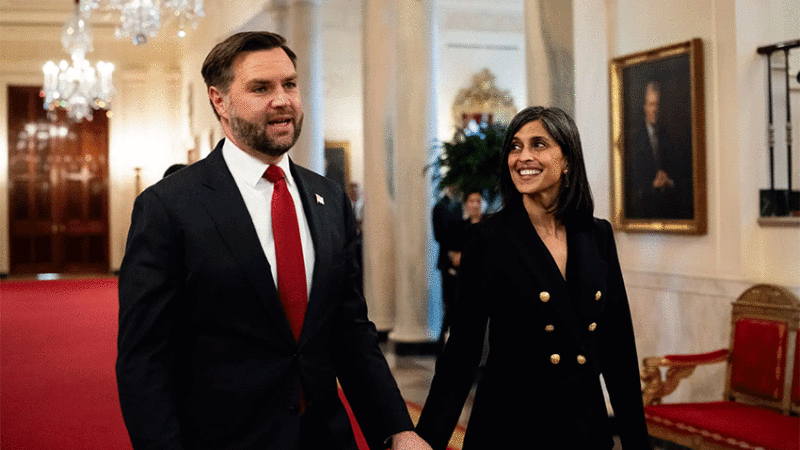
Journey Tribune – Vice President JD Vance and his wife, Usha Vance, announced on Tuesday that they are expecting their fourth child, a baby boy due in late July, marking a rare and historically notable moment in modern American politics. The news makes Usha Vance the first known sitting second lady in contemporary U.S. history to be pregnant while her husband serves in office.
The couple shared the announcement in a joint statement posted on social media, expressing both excitement and gratitude. “We’re very excited to share the news that Usha is pregnant with our fourth child, a boy,” they wrote. “Usha and the baby are doing well, and we are all looking forward to welcoming him in late July.” The Vances also offered thanks to their staff and to the military physicians who have been caring for the family.
Mr. Vance, 41, and Ms. Vance, 40, are already parents to three young children: two sons, Ewan and Vivek, and a daughter, Mirabel. The couple met in 2010 while studying at Yale Law School and were married four years later in Kentucky. Since then, their family life has been a recurring point of public interest, particularly as Mr. Vance has risen rapidly from author and venture capitalist to U.S. senator and, most recently, vice president.
The pregnancy announcement carries symbolic weight beyond the personal milestone. It comes at a time when family policy, fertility rates, and cultural debates over parenthood have become prominent themes in national political discourse. Mr. Vance has repeatedly emphasized what he describes as a “pro-family” agenda, openly encouraging higher birth rates and arguing that public policy should better support parents and children.
At last year’s Right to Life March, he drew attention for declaring that the country needed “more babies in the United States of America,” a remark that was widely interpreted as both a cultural statement and a policy signal amid concerns about declining fertility rates. Those views have earned him praise from social conservatives and criticism from others who view such rhetoric as overly prescriptive or insufficiently attentive to economic realities facing young families.
Ms. Vance herself touched on her husband’s priorities during her speech at the Republican National Convention in 2024. She said his “one overriding ambition” was “to become a husband and a father and to build the kind of tight-knit family that he had longed for as a child.” That personal narrative, allies say, has shaped both his political identity and his public messaging.
Colleagues and supporters often describe Ms. Vance as an embodiment of the family-centered values her husband promotes. While she has largely avoided the spotlight and spoken sparingly about her private life, those close to the administration have said she is widely viewed as a model figure within the broader pro-family movement associated with the vice president.
The White House moved quickly to acknowledge the announcement. An official social media account congratulated the couple and described the current leadership as “the most pro-family administration in history,” language that echoed campaign themes and underscored the political resonance of the moment.
Despite her generally low public profile, Ms. Vance has appeared alongside her husband and their children on several high-profile international trips. The family has attended Good Friday services at the Vatican and dined in New Delhi with India’s prime minister, signaling a willingness to integrate family life into the ceremonial and diplomatic aspects of the vice presidency. Even so, Ms. Vance has remained cautious about sharing details of her personal life, maintaining a clear boundary between public duties and private family matters.
The timing of the announcement also drew attention because it followed closely on another high-profile pregnancy within the administration. Less than a month ago, White House press secretary Karoline Leavitt revealed that she was expecting a baby girl in May. The two announcements together have fueled commentary about a distinctly family-oriented tone within the current White House.
Historians and political observers noted the rarity of a second lady being pregnant while in office. While presidents and vice presidents have welcomed children during their terms in earlier centuries, such occurrences have been uncommon in the modern era, when the average age of national political leaders has steadily increased.
For the Vances, however, the moment appears primarily personal. Their statement focused on gratitude, health, and anticipation rather than politics. Still, in a climate where private lives of public officials are often interpreted through a political lens, the news is likely to remain part of broader debates over family values, demographic change, and the role of government in supporting parents.
As July approaches, the vice president and his wife will prepare to welcome a new child while navigating the demands of the national office. For supporters, the pregnancy reinforces the authenticity of Mr. Vance’s family-first message. For critics, it may serve as another flashpoint in debates over how personal beliefs intersect with public policy. Either way, the arrival of the Vances’ fourth child is poised to become a small but symbolically charged chapter in the unfolding story of this administration.
