
Did Trump Change MLK Day? What’s New About the 2026 Holiday

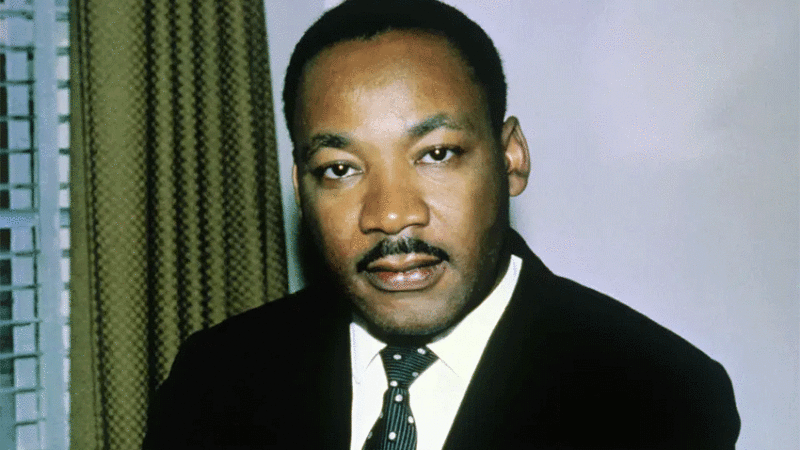
Journey Tribune – Martin Luther King Jr. Day will still be observed nationwide on Monday, Jan. 19, 2026, honoring the legacy of the civil rights leader who helped transform American democracy. But for millions of Americans accustomed to visiting national parks for free on the holiday, this year’s observance comes with a notable change: free admission to National Park Service sites will no longer be offered on MLK Day.
The shift follows new federal guidelines issued under President Donald Trump’s administration, which removed Martin Luther King Jr. Day — along with Juneteenth — from the list of fee-free entrance days at national parks and other federally managed public lands. The change does not eliminate the holiday itself, which remains protected by federal law, but it alters how the federal government marks the occasion.
Under the new policy, national parks will continue to offer a limited number of free entry days in 2026, beginning with Presidents Day on Feb. 16. Those days, however, will now be restricted to U.S. citizens and legal residents, a departure from past years when free access was extended more broadly.
The removal of MLK Day from the free-entry calendar has drawn attention because the holiday had long been associated with public access to parks as a way to honor King’s legacy of service and civic engagement. The National Park Service had previously included the holiday among dates recognizing significant moments in American history, particularly those tied to African American heritage.
Federal officials confirmed that the Department of the Interior canceled fee-free admission for both Martin Luther King Jr. Day and Juneteenth, the latter commemorating the end of slavery in the United States. Critics say the decision signals a reduced emphasis on honoring Black history through public land programming.
Still, the holiday itself remains firmly in place. Martin Luther King Jr. Day is a federal holiday established by Congress and signed into law by President Ronald Reagan in 1983. It was first observed in 1986 and is held annually on the third Monday in January, near King’s birthday on Jan. 15. Changing or eliminating the holiday would require an act of Congress — a step no administration can take unilaterally.
Presidential authority, however, does extend to how federal holidays are administered. Through executive action, the president can modify federal observances, including decisions about agency operations and special programming such as free park days. Those orders typically apply for one year at a time.
In 2026, the National Park Service has scheduled eight fee-free days, beginning later in the winter. The dates include Presidents Day on Feb. 16, Memorial Day on May 25, Flag Day and President Trump’s birthday on June 14, the Independence Day weekend from July 3 through July 5, the National Park Service’s 110th anniversary on Aug. 25, Constitution Day on Sept. 17, President Theodore Roosevelt’s birthday on Oct. 27, and Veterans Day on Nov. 11.
By contrast, the 2025 calendar had included a broader slate of free-entry days, among them Martin Luther King Jr. Day, Juneteenth, National Park Week, Great American Outdoors Day, and National Public Lands Day. The revised list marks a significant narrowing of opportunities for visitors to enter parks without paying standard entrance fees.
What does this mean for visitors in practical terms? On free-entry days, the National Park Service waives the usual entrance fees at participating sites. Other charges — such as those for camping, tours, or special activities — may still apply, and reservations may still be required. Outside of those designated days, visitors must pay regular entrance fees, which vary by park and can be found on the agency’s website.
The impact is being felt across the country, including in Michigan, which is home to several major National Park Service sites. Sleeping Bear Dunes National Lakeshore, known for its sweeping sand beaches, forested trails, and towering bluffs along Lake Michigan, will charge regular admission on MLK Day for the first time in years. Isle Royale National Park, one of the nation’s least-visited parks, remains closed through mid-April due to winter conditions, but the new policy will apply when the park reopens. Keweenaw National Historic Park, which preserves the region’s copper mining heritage, and North Country National Scenic Trail, which spans more than 1,100 miles across Michigan, are also subject to the updated guidelines.
Other Michigan sites, including Pictured Rocks National Lakeshore and River Raisin National Battlefield Park, will likewise no longer participate in free admission on the January holiday.
The National Park Service, which manages more than 400 sites nationwide, has not announced whether the policy will continue beyond 2026. For now, visitors planning trips around holiday weekends are being advised to check the updated calendar carefully and confirm entrance fees in advance.
While Martin Luther King Jr. Day remains a day of reflection, service, and remembrance across the country, its connection to free access to America’s public lands has been quietly severed — at least for this year — marking a subtle but symbolic shift in how the federal government observes one of its most significant civil rights holidays.
