
Dilbert Creator Scott Adams Dies at 68 After Cancer Battle

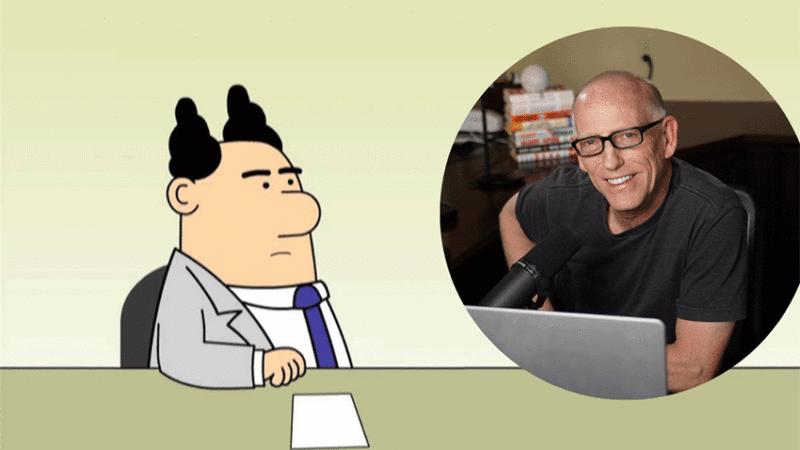
Journey Tribune – Scott Adams, the American cartoonist best known for creating the long-running comic strip Dilbert, has died at the age of 68 following a battle with aggressive prostate cancer. Adams passed away on January 13, 2026, at his home in Pleasanton, California, according to confirmation from his former wife, Shelly Adams. She stated that he had been receiving hospice care in the final stage of his illness.
Adams publicly disclosed his diagnosis in May 2025, revealing that the cancer was advanced and had significantly limited his treatment options. His death marks the end of a career that profoundly shaped workplace humor for more than three decades, while also becoming increasingly defined by controversy in its later years.
Launched in 1989, Dilbert quickly distinguished itself by offering a sharp, satirical look at corporate life through the eyes of a socially awkward engineer trapped in a maze of bureaucracy, illogical management decisions, and office politics. The strip resonated with millions of workers who saw their own frustrations reflected in its characters, including the hyper-competent but perpetually sidelined Alice and the manipulative, power-hungry Dogbert.
The popularity of Dilbert grew rapidly throughout the 1990s and early 2000s. At its peak in 2013, the comic was syndicated in approximately 2,000 newspapers across 65 countries, making Adams one of the most widely read cartoonists in the world. The franchise expanded beyond print to include books, calendars, merchandise, video games, and a two-season animated television series that aired on UPN from 1999 to 2000, featuring a theme song by composer Danny Elfman.
Adams’ success also extended into corporate advertising, most notably a high-profile Office Depot campaign in 199,7 reportedly valued at $30 million. At the height of its influence, Dilbert was not only a comic strip but a cultural shorthand for the absurdities of modern office life.
However, Adams’ public image underwent a dramatic shift in the 2010s as his commentary outside the comic increasingly drew criticism. Through his podcast Real Coffee with Scott Adams, he shared provocative and often inflammatory opinions on politics, race, and social issues. The backlash reached a breaking point in February 2023, when Adams made remarks about Black Americans while discussing a Rasmussen poll on race-related attitudes.
His comments, which included urging white Americans to distance themselves from Black Americans and referring to Black Americans as a “hate group,” sparked widespread condemnation. More than 1,000 newspapers dropped Dilbert in response, including major outlets such as The Washington Post, The Los Angeles Times, and The Boston Globe. Andrews McMeel Universe, the strip’s longtime publisher, severed ties with Adams, as did Penguin Random House, which canceled plans to release his forthcoming book.
Adams defended his statements as hyperbolic and denied being racist, but the fallout effectively ended Dilbert’s mainstream presence. He later attempted to revive the strip through a paid online subscription model titled Dilbert Reborn, hosted on the Locals platform. The effort attracted a smaller, more politically aligned audience but never regained the strip’s former reach.
The controversies were not limited to race. Adams faced criticism for questioning historical Holocaust death tolls and for his unwavering support of Donald Trump, whom he backed publicly during the 2016 election and afterward. In a 2025 podcast episode, Adams claimed that his political stance cost him his career, reputation, and social standing, a sacrifice he said he believed was justified.
Born on June 8, 1957, in Windham, New York, Adams initially pursued a more conventional career path. He earned a degree in economics from Hartwick College and later worked at Crocker National Bank, where his experiences as a middle manager inspired the early concepts for Dilbert. Drawing caricatures of coworkers and supervisors eventually evolved into the strip that defined his legacy.
Adams was married twice and divorced twice. He is survived by three stepchildren and two siblings.
While Scott Adams will be remembered for his sharp observations of corporate culture and his impact on workplace humor, his legacy remains deeply divided—split between creative achievement and the controversies that ultimately overshadowed his work.
