
Why Susie Wiles Is Finally Talking About Trump

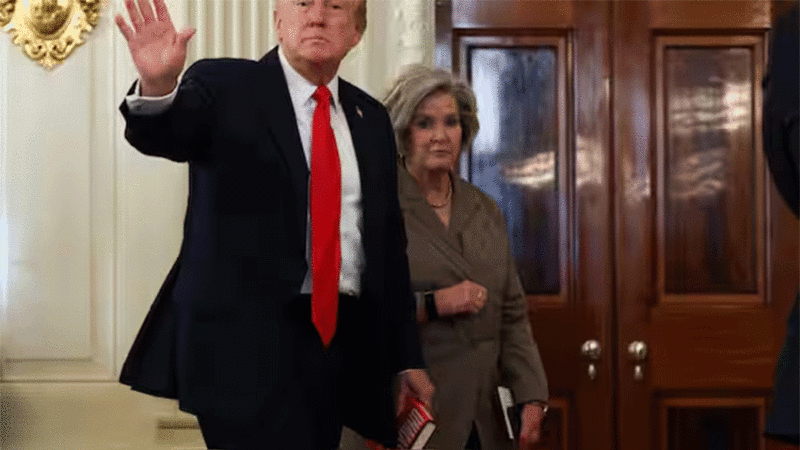
Journey Tribune – Susie Wiles, the powerful and famously discreet White House chief of staff, has offered one of the most candid assessments yet of President Donald Trump’s personality and governing instincts, describing him as having “an alcoholic’s personality” in a revealing interview with Vanity Fair.
The remark, published as part of an in-depth profile by veteran political journalist Chris Whipple, has sent ripples through Washington, not only because of its bluntness but also because of its source. Wiles, the first woman to serve as White House chief of staff, is widely viewed as the central stabilizing force in Trump’s second administration and one of the president’s most trusted confidantes.
According to Vanity Fair, Wiles did not use the phrase to suggest that Trump struggles with alcohol abuse. Instead, she was referring to what she described as a compulsive personality marked by absolute confidence, denial of limits, and a belief that obstacles can always be overcome through sheer force of will. Trump, she said, operates with the conviction that “there’s nothing he can’t do. Nothing, zero, nothing.”
The description carries particular resonance given Wiles’ personal history. Her father, the late Pat Summerall — a celebrated NFL announcer and sports broadcaster — battled alcoholism for years before achieving sobriety. In the interview, Wiles reportedly drew on that experience to articulate what she sees as Trump’s relentless self-belief, a trait that she appears to regard as both an asset and a liability.
Trump has long been known for his unshakable confidence and defiance of convention, qualities that propelled his rise in politics and sustained his return to the White House in 2025. Supporters argue that this mindset enables him to challenge entrenched institutions, resist political pressure, and pursue policies others would abandon. Critics, however, have warned that the same traits can lead to impulsive decision-making, resistance to expert advice, and a tendency to escalate conflicts.
Wiles’s comments offer rare confirmation that these concerns are openly acknowledged within Trump’s inner circle.
Despite the striking nature of her remarks, the Vanity Fair profile does not portray Wiles as a critic or adversary of the president. On the contrary, Trump has publicly praised her on multiple occasions, referring to her as the “ice maiden” — a nickname meant to reflect her discipline, emotional control, and ability to manage chaos. He has credited her with playing a decisive role in both his 2024 campaign and the early consolidation of power during his second term.
Unlike many of Trump’s previous chiefs of staff, Wiles has largely avoided becoming a public figure. She operates behind the scenes, enforcing structure, controlling access to the Oval Office, and managing competing factions within the administration. Her low-profile approach stands in sharp contrast to the infighting and turnover that characterized Trump’s first term.
The Vanity Fair article suggests that Wiles views her role as translating Trump’s instincts into workable governance while containing their more destructive potential. The profile references her interactions with other influential figures in Trump’s orbit, including Vice President JD Vance and technology billionaire Elon Musk, both of whom wield significant influence over policy and political strategy.
While the interview stops short of offering direct criticism of these figures, it implies that Wiles often acts as a mediator, balancing ambition, ideology, and loyalty within an administration defined by strong personalities.
Political observers say the significance of Wiles’ comments lies not only in what she said, but in the fact that she said it at all.
“It’sscarcee for a sitting chief of staff to speak in psychological terms about a president,” said a former senior White House aide familiar with executive branch dynamics. “That tells you two things: first, that this personality is central to how the administration functions, and second, that managing it is seen as part of the job.”
Reaction to the interview has been sharply divided along partisan lines. Trump allies have dismissed the controversy, arguing that Wiles’ description merely underscores the president’s determination and refusal to accept defeat. They note that Trump does not drink alcohol and has often cited his brother’s struggles with addiction as a reason for abstinence.
Critics, meanwhile, have seized on the remarks as evidence that even Trump’s closest aides recognize the risks inherent in his leadership style. Some have compared the comments to previous accounts from former officials who described a president resistant to restraint and skeptical of institutional guardrails.
The White House has not issued an official response to the Vanity Fair report, and Trump himself has not publicly addressed Wiles’s remarks. People familiar with their working relationship say the president continues to rely heavily on her judgment and trusts her implicitly.
As Trump’s second term progresses amid domestic polarization and global uncertainty,Wiles’s’ unusually frank assessment offers a rare glimpse into the psychological engine driving the presidency. Whether viewed as a warning, a diagnosis, or simply an honest portrait, her words underscore a central reality of Trump’s leadership: belief — unyielding and absolute — remains the defining force at the heart of his administration.
