7.5 Earthquake Strikes Japan – Authorities’ Fast Move Praised

Journey Tribune – A powerful magnitude 7.5 earthquake rocked northern Japan late Monday night, injuring at least 30 people, disrupting transportation networks, and forcing tens of thousands of residents to flee coastal areas amid tsunami warnings. The tremor—one of the strongest to hit the region in recent years—struck at 23:15 local time (14:15 GMT) and prompted an immediate emergency response from national and regional authorities.
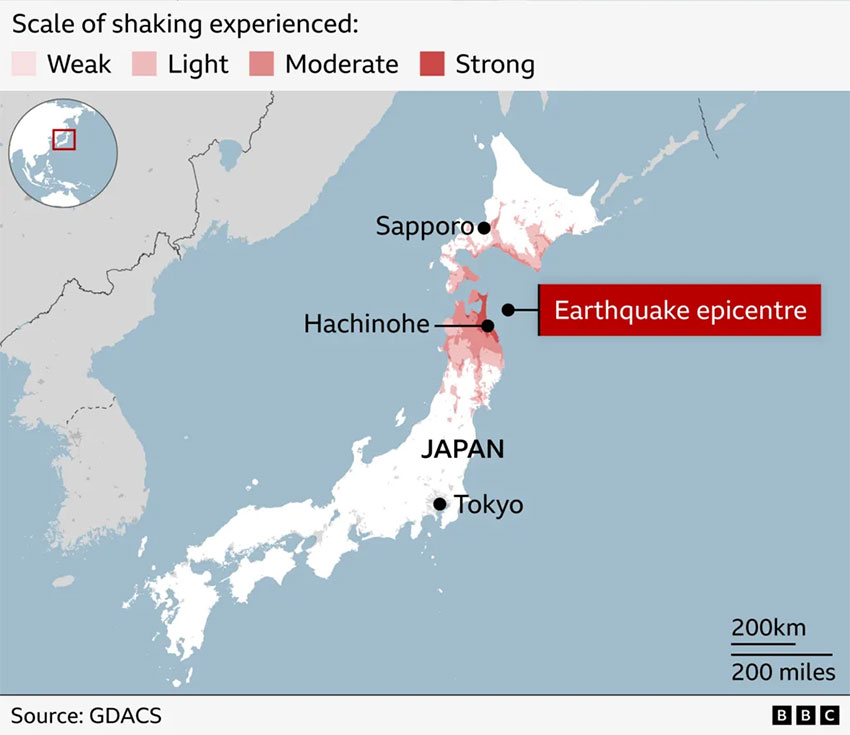
According to the Japan Meteorological Agency (JMA), the earthquake originated approximately 80 km off the coast of Aomori Prefecture at a depth of around 50 km. Though initial tsunami alerts were lifted several hours later, the agency reported that waves reaching 70 cm had already hit parts of the northeastern coastline. Experts cautioned that aftershocks, including potentially severe ones, may occur in the days to come.
Thousands Ordered to Evacuate
Emergency officials issued evacuation orders to an estimated 90,000 residents, particularly in low-lying areas vulnerable to tsunami surges. Local shelters quickly began receiving evacuees as authorities urged citizens not to return home until infrastructure safety checks were completed.
The Aomori prefectural government confirmed that around 2,700 households were left without electricity following the quake. Power companies warned that full restoration may take several hours as engineers assess structural damage and repair faults triggered by violent shaking.
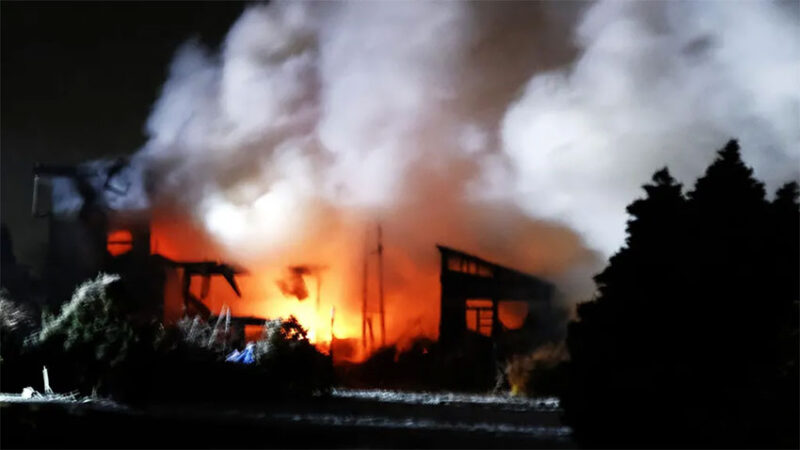
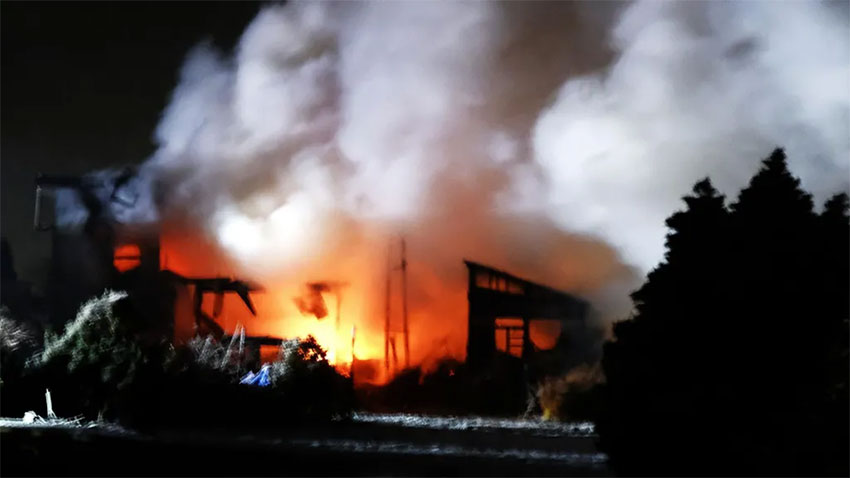
Images shared by local media showed residents scrambling to secure belongings and navigate darkened neighborhoods, while emergency sirens blared across several coastal towns. In Aomori, firefighters also battled a residential blaze that erupted shortly after the tremor, though it remained unclear whether the quake directly caused the fire.
Transport Services Halted
The earthquake caused major disruptions to transportation across the region. East Japan Railway suspended several train lines serving the northeastern coast, citing the need for safety inspections. Some services were halted indefinitely while teams evaluated track integrity and station structures.
Highways in Aomori and neighboring prefectures were also temporarily closed due to reports of cracks and minor landslides. Authorities warned motorists to remain vigilant as aftershocks continue.
Government Mobilizes Emergency Response Team
Prime Minister Sanae Takaichi addressed the nation shortly after the quake, urging residents to remain alert and prepare for potential additional seismic activity.
“Please reconfirm your household earthquake preparedness—secure furniture, maintain emergency supplies, and be ready to evacuate immediately if you feel strong shaking,” she said during a televised statement.
The government quickly established a disaster response office within the Prime Minister’s Crisis Management Center, deploying specialized teams to assess infrastructure damage and coordinate rescue and relief operations. Chief Cabinet Secretary Minoru Kihara emphasized that authorities were “making every effort to evaluate the situation on the ground and provide rapid assistance to affected communities.”
Nuclear Facilities Report No Irregularities
Despite concerns raised by the quake’s intensity, major nuclear power facilities in the region reported no signs of malfunction. Tohoku Electric Power confirmed that both the Higashidori and Onagawa nuclear plants remained stable, with no irregularities detected.
Japan’s authorities also notified the International Atomic Energy Agency (IAEA) that no issues had been observed at the Fukushima Daiichi nuclear site, which suffered catastrophic damage during the 2011 magnitude 9.0 earthquake and tsunami.
Japan’s High Seismic Risk Continues to Raise Concerns
Japan experiences roughly 1,500 earthquakes annually due to its location along the Pacific Ring of Fire, one of the world’s most seismically active zones. Earlier this year, the country’s Earthquake Investigation Committee warned of a 60–90% likelihood that a devastating “megaquake” could strike the Nankai Trough—a major fault line along Japan’s Pacific coast—within the next 30 years.
Such an event, the panel noted, could result in hundreds of thousands of fatalities and cause trillions of dollars in economic damage, underscoring the importance of ongoing preparedness.
As northern Japan begins damage assessments and recovery efforts, officials are urging residents to remain cautious for at least a week. With the possibility of additional strong tremors looming, communities across the region continue to brace themselves—mindful that Japan’s seismic future remains both unpredictable and perilous.